Laboratoire de Physique de l’Ecole Normale Superieure (LPENS), France


Extreme Optical Nonlinearities in 2D materials for Far Infrared Photonics
European Union’s Horizon 2020 research and innovation programme
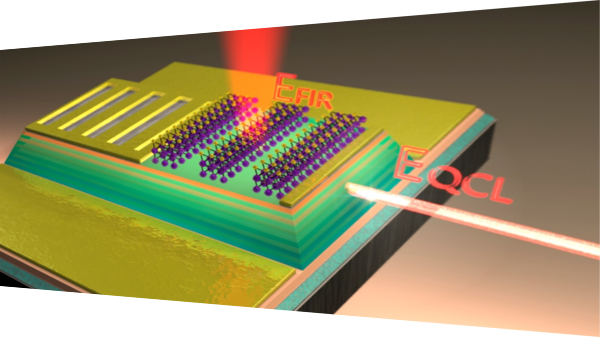
The generation of light across the mid-infrared (MIR) and terahertz (THz) spectral regions of the electromagnetic spectrum has become an enabling technology, opening up a plethora of sensing applications across the sciences, as well as enabling the study of fundamental light-matter interactions. The key disruptor in this domain is the quantum cascade laser (QCL), which has grown from a laboratory curiosity to become an essential and practical optoelectronic source for a broad range of application sectors. The expansion of applications has, however, highlighted a technology gap lying between the MIR and THz domains, between 25 μm and 60 μm (5 – 12 THz), which is termed the far-infrared (FIR). Compared to neighbouring MIR and THz domains, the FIR lacks solid-state source technologies, despite the many sensing applications that such compact sources would enable.
In the EXTREME-IR project we will breakthrough this technological barrier by pioneering a radically new platform exploiting nonlinear optics in 2D materials to realize functionalized, compact and coherent FIR sources. 2D materials are becoming an important area of scientific interest owing to their unique optical and electronic properties, distinct from bulk materials and conventional semiconductors.This has led to an extensive applicative potential ranging from quantum optics at room temperature to the next generation of ultrafast electronics. However, they have not been exploited for the FIR. Here we will use the distinct phonon spectra and extreme nonlinearities in 2D transition metal dichalcogenides (TMDs) and Dirac matter (DM) to create new optoelectronic sources for the FIR. In particular, we will capitalize on the new phenomena of giant room temperature intra-excitonic nonlinearities and efficient high harmonic generation through plasmonics and resonators, combined with state-of-the-art QCLs as optical pump sources, to access and exploit this unexplored electromagnetic region fully for the first time.
This Project has received funding from the European Union’s Horizon 2020 research and innovation programme under grant agreement N° 964735










Coordinator
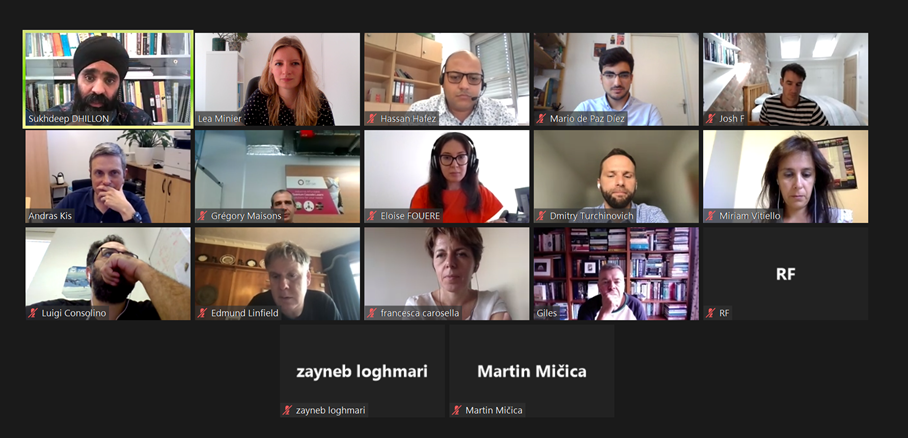
Dr Sukhdeep Dhillon is a CNRS researcher in charge of the Nano-THz team at LPENS and is the coordinator of the EXTREME-IR project.
Contact :